
2025-26 NHL Power Rankings: 20-Game Mark
November 26, 2025
Jarry for Skinner is a lateral move for the Oilers
December 12, 2025
December 6, 2025 by Dash in the Park
There are moments in hockey when you can feel something that the numbers do not quite capture. You watch a player and your eyes tell you one story while the spreadsheets tell you another. If you have watched enough hockey, if you have lived it and played it and argued about it in freezing parking lots after midnight, then you know exactly what I am talking about.
This season, a lot of people have looked at Connor McDavid and said something that sounds almost forbidden. Something you whisper because saying it at full volume feels like a crime against the sport. They say he looks like he is bobbling the puck more. They say he looks a little wobbly. They say he looks like he might have lost a step.
Right away, you feel that defensive twitch because you know that if McDavid ever truly lost a step, the entire league would collapse into the nearest crater. But you have seen it with your own eyes: those little puck pops, those half touches, those moments when he comes flying into the zone and the puck behaves like it is suddenly seeing the bright lights of an oncoming train.
So maybe you start wondering… Is there something there? Is there something real behind the eye test? Is this the beginning of the decline story? Is this the first chapter of the aging superstar novel that every great player eventually has to read?
No. It is not.

If anything, the explanation lives at the opposite end of the spectrum. McDavid hasn’t lost a step. He has gained one. That new gear is so violent and so outside the bounds of what hockey was designed for that the puck is simply failing to keep up.
I know that sounds like a joke. I know it sounds like something you would say in a beer league room after a game; but the more you dig into it, the more it stops being funny and the more it becomes obvious.
McDavid is playing hockey in a speed range that does not exist for anyone else. The sport has no language for it. The analytics have no established terms for it. The puck itself was never designed to behave at that velocity. The physics of the game are tapping out at the edge of his acceleration curve.
This is not decline. This is a player discovering an entirely new velocity band and dragging the puck along like an unwilling passenger.
The new league wide puck and jersey tracking system, EDGE, has shown a number that is impossible to ignore. McDavid reached a top speed of 24.6 miles per hour on a rush during an Edmonton Oilers powerplay at 8:04 of the second period of the team’s season opener against the Calgary Flames. That’s the fastest speed ever recorded for him. It’s the fastest in the league this season and the second fastest measurement in the modern tracking era (Miles Wood – 24.81 mph in 2024-25).
That’s not an isolated burst. McDavid is also leading the league in high speed bursts above 20 mph and above 22 mph. He has either led or tied for the league in bursts above 22 mph in every year but one since this tracking started in 2021-22. Nathan MacKinnon had 117 such bursts in 2023-24, which dummies the second highest ever total, McDavid’s 89 from 2021-22. McDavid is already at 47 through 28 games. That’s more than double the amount that anyone else has this season. That’s a 138 burst pace. At this rate, McDavid will smash a record that’s already leaps and bounds above the field.
In the simplest terms possible, he has discovered an entirely new gear. One that did not exist in his game five years ago. One that is outside the established ranges of puck handling mechanics. One that pushes his overall skating velocity into a place where even his world class hands have never had to operate before.
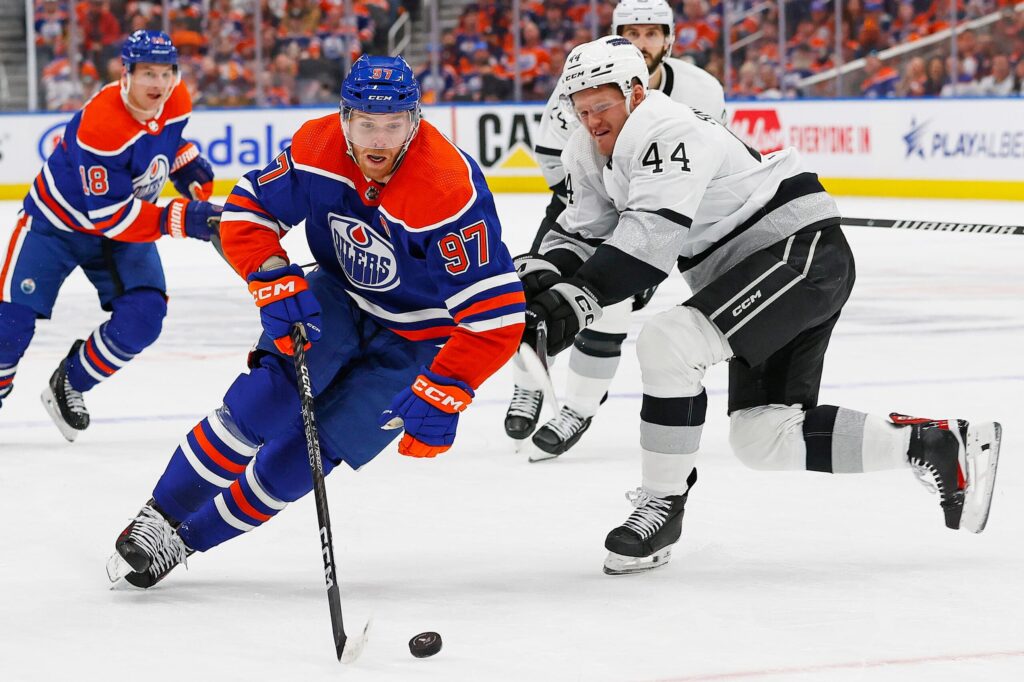
The result is that when he hits this new top speed, the puck becomes dynamically unstable. Not because his touch is worse or because his hands have aged. It’s because the surface area contact between the blade and the puck shrinks at that speed. The time of contact between the puck and the blade becomes so short that even the slightest ice imperfection, the smallest vibration, or the tiniest microscopic ridge will send the puck hopping.
To understand what is actually happening, you have to picture something that coaches talk about privately but almost never discuss openly. Every hockey player has a puck handling speed ceiling. A point where their hands reach the limit of what the human body can process while the legs are hammering away underneath. For most NHL forwards, that ceiling lives around 18 to 20 mph. Above that, you will see wobbles. You will see forced dumps. You will see even elite players concede the rush because their hands cannot safely control the puck at that pace.
McDavid has always been different. His top speed with the puck has always been higher than anyone else’s. That’s the reason he had that classic video game look where the puck seemed glued to his blade even though his legs were spinning like a turbine. His control range used to sit right under his physical speed limit, which meant he could reach his top gear without blowing past his own puck handling comfort zone.
That is how he built his legend. That is how he diced through the entire league. He never had to downshift to manage the puck. His top gear was part of his skill package.
This season, McDavid is trying to push that puck handling speed ceiling higher. We are watching the first athlete in the history of the game to ask a puck to perform at this velocity on command. The six ounce disc of vulcanized rubber is doing the best it can. It is just physically overwhelmed once McDavid hits the gas.
Related: Connor McDavid’s desire to win is unrivaled
That’s why the bobbles happen. The bobbles are not his flaw. They are the visible side effect of a player hitting speeds that defy the design of the sport. He’s not losing control. He’s exceeding the boundaries of the physics model.
Imagine driving a sports car that suddenly gets an engine upgrade without upgrading the suspension. That shaking you feel is not the car falling apart, it’s the limit of the older parts being exposed by the newfound horsepower. That’s McDavid right now.
When you realise this. you stop worrying. You stop thinking about his decline. You stop analyzing every bobble as if it is a referendum on his long term future. Instead, you see a player who has discovered the next frontier of skating power. A frontier no one else has found.
This is not a tragedy. This is not a decline story. This is not the slow fade of a generational talent. It is the opposite. It is evolution in real time.
If anything, it should scare the rest of the sport. The true absurdity of the situation is that to get full control back, all he needs to do is slow down a little bit. Let the puck catch up. Let the physics settle. If McDavid ever decides to throttle down just slightly, he will look as smooth as he ever has and he will dominate with that terrifying combination of glide, control, and pace that made him the stuff of nightmares for defenders.
But that has never been who he is. He pushes, he tests, and he explodes into space. He treats the neutral zone like a runway and the puck like cargo strapped to a rocket.
People will always rush to write the decline narrative. It is the oldest reflex in hockey fandom. But this is not the start of that chapter. This is the messy transitional moment. The moment where a player discovers a new layer of performance.
Perhaps his hat trick on Thursday against the Seattle Kraken is a sign that he’s starting to figure it out.