Coffey to the rescue again
February 19, 2026
Don’t read much into these Oilers roster moves
March 2, 2026
February 22, 2026 by Ryan Lotsberg
Let me open this piece by congratulating the United States on their gold medal wins in both men’s and women’s hockey at the 2026 Winter Olympics in Milano Cortina.
The stars (and stripes) aligned for the American men on Sunday. First of all, their gold medal victory came on the anniversary of the Miracle on Ice (February 22, 1980) in Lake Placid, their most recent gold medal before Sunday. It was also George Washington’s heavenly birthday (February 22, 1732).
Lastly, it was also Johnny Gaudreau Jr’s second birthday. American players brought the late Johnny Gaudreau’s jersey onto the ice for their celebration, and both of Gaudreau’s children were brought onto the ice to be a part of their team photo. It was a touching tribute to Gaudreau.
Jack Hughes’ performance will live in hockey lore forever. He lost part of his front tooth late in the third period, which resulted in a four-minute powerplay for the US. Hughes then took a penalty to negate a significant chunk of that powerplay and to give Canada a late powerplay. Hughes ended up scoring the “golden goal” in overtime.
Connor Hellebuyck exorcised his big-game demons with an outstanding performance in the gold medal game. The Americans were outshot 28-42, and Hellebuyck only allowed one goal. Many of his 41-saves came on grade A scoring chances. Hughes’s moment will be remembered forever, but Hellebuyck was the real MVP for the Americans in the gold medal game.
The American women fully earned their gold medal. The only game that was close between them and the Canadian women’s team in the lead up to the Olympics and during the Olympics was the gold medal game, a 2-1 overtime win for the US. Scoring the game-tying goal in the dying minutes of regulation time en route to a gold medal was a fitting way for American legend Hilary Knight to end her Olympic career.
I had to give the Americans their kudos, but as a Canadian and a writer for a Canadian hockey website, I’m not here to shower the US teams with praise.
I’m always proud of the athletes that represent Canada, and I admire the way they left everything they had on the ice. Being the second best hockey team in the world is no small feat; but no matter how hard we try to find one, there’s no silver lining in winning silver in hockey, especially in Canada.
The Canadian men heavily outplayed the Americans, as the 42-28 shot line indicates; but sometimes it’s just not your day. That was the case on Sunday.
They had their chances to end that game in regulation time. Neither Nathan MacKinnon nor Devon Toews will get much sleep over the coming days as both missed nearly unmissable scoring chances. MacKinnon, who is widely regarded as a top three if not a top two player in the world, hit the side of the net when he had a yawning cage facing him. He rarely misses those shots. Hellebuyck somehow got his stick on Toews’ chance from inside the crease while down and seemingly out.
Connor McDavid, the tournament scoring leader and tournament MVP that set a new record for points in a single Olympic tournament with NHL player participation (13), and sophomore standout Macklin Celebrini both failed to convert breakaway chances into goals. Celebrini put himself in all sorts of great scoring positions throughout the gold medal game, but the tournament goal scoring leader coudn’t bury one on Sunday.
That’s just the kind of day it was for the Canadian men.
The Canadian women suffered the same fate, a silver medal thanks to a 2-1 overtime loss to the Americans; but they arrived there in opposite fashion to their male counterparts. They got a shorthanded goal from unlikely goal scorer Kristin O’Neill 54 seconds into the middle frame and held on for dear life afterwards. They could only hold on for so long though. Knight tied it with 2:04 remaining in regulation time, and Megan Keller won it with a beautiful one-on-one move and finish in overtime.
Both Canadian teams will think of the “what ifs” for the rest of their lives. What if MacKinnon had hit that empty net, if Toews had been able to slide that chance in, or if either breakaway had not been stopped? What if Cale Makar had been able to get a stick on the puck inside the US blue line before the sequence that led to Hughes’ game winning goal? What if Knight’s deflection had been blocked before it got to her stick? What if the puck hadn’t snuck between the arm and body of Ann-Renée Desbiens in overtime?
Those are the minsicule differences between elation and devastation at the Olympics.
Both Canadian teams were in positions to win those games, but the reality is they didn’t. That’s the way it goes sometimes, and it sucks.
Roster Construction
Now, we deal with the aftermath. Both Canadian teams will be criticized for their roster decisions because they didn’t win. I think that both teams made questionable decisions, and I felt that way before the tournament started. Gold medals wouldn’t have changed my opinion, but they would’ve kept me quiet.
Head coach Jon Cooper gave McDavid 24:01 of ice time in the gold medal game. Meanwhile, Seth Jarvis got 7:59 and Sam Reinhart got just 6:57. I’m not saying those two specifically deserved to steal some ice time from McDavid. I’m using those numbers to illustrate the point that team Canada found a way to not be deep, which is unfathomable based on how much talent was available to them.
McDavid ended up with thirteen points in the tournament. Celebrini was stapled to McDavid’s side for the entirety of the tournament, and he got ten points. Next down the list was MacKinnon at seven points, just barely over half of McDavid’s output. Those three were routinely stacked together.
The line of Sidney Crosby (who missed the last two games of the tournament), Mitch Marner, and Mark Stone had six, five, and four points respectively. Crosby was on the powerplay, and Marner got an overtime goal while playing without those two, so Stone’s four points are the most representative of how that line fared at five-on-five.
Tom Wilson, who was with McDavid and Celebrini when MacKinnon wasn’t, also got four points. No other Canadian forward aside from the ones mentioned above had more than two points in the tournament. I can’t comfortably call it a two-line team. It was a one-line team.
As odd as it is to say about a team that led the tournament in goal scoring, it felt like Canada could’ve used more scoring punch. They struggled to score in the medal round while players like Connor Bedard, Zach Hyman, and Mark Scheifele sat at home watching.
The criticism of the Canadian men’s defence was their puck moving ability. Players like Colton Parayko and Travis Sanheim were chosen for their defensive prowess and their penalty killing ability. Meanwhile, Canada struggled to move the puck at times. Losing Josh Morrissey early in the tournament hurt, but Evan Bouchard skating with the Edmonton Oilers rather than Team Canada on Sunday seems peculiar in retrospect.
The Canadian women’s team had their own set of roster issues. They brought zero women under the age of 24 while the Americans brought eight. The speed of the Americans exposed a weakness of the Canadians in the two games that the sides played in the Olympics. Nineteen year old NCAA standout Chloe Primerano was a controversial snub from this team, and it’s hard to imagine that she wouldn’t have improved a defence that proved to be too slow.
Legacy
It was likely the Olympic finale for Canadian legend Marie-Philip Poulin. A second silver medal won’t tarnish the legacy of “Captain Clutch”. The three-time Olympic gold medallist and all-time Canadian female Olympic scoring leader will always be a legend in Canadian hockey. She’s a winner through and through.
This might be the end of the Olympic road for other veterans on the women’s side if the results of this tournament indicate anything.
The men’s team that was sent to Milano was special because it featured three generations of superstars. Sidney Crosby and Drew Doughty both represented Canada for the third consecutive Olympics where NHL players were allowed to compete. This was the first Olympic opportunity for every other Canadian male player. McDavid, MacKinnon, and Makar represented the current generation, and Celebrini represented the next wave of Canadian talent.
Crosby and Doughty had the chance to win their third consecutive gold medal, something no NHL player has ever done. Both Crosby and Doughty have won multiple Stanley Cups in addition to their two Olympic gold medals and a silver medal. They will be remembered as winners if this was their last Olympic opportunity.
Crosby’s “golden goal” in Vancouver in 2010 is an iconic moment in Canadian history. It was a shame to see Crosby injured in the quarterfinal, and I hope that he hasn’t played his last game at the Olympics; but it’s hard to imagine a 42-year old NHLer making an Olympic team. Crosby is one of the rare few that could potentially do it.
MacKinnon and Makar have their Stanley Cup win, but a missing gold medal will prevent their legacies from reaching the levels of Crosby and Doughty. There’s tons of time for Celebrini to write his story with his career still very much in its infancy.
The silver weighs heaviest around the neck of McDavid though. McDavid is regarded as the best player in the world, and his Olympic tournament proved that. He separated himself from any of his peers, including MacKinnon, in that conversation with his thirteen point MVP performance.
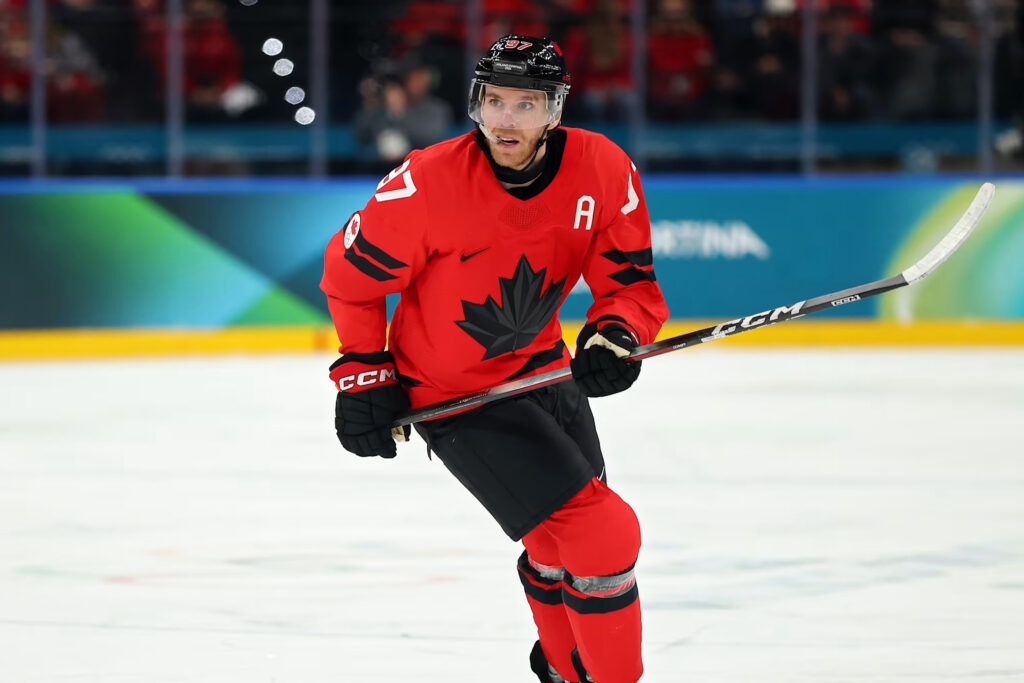
However, he didn’t come through when the lights were brightest… again.
McDavid has now lost two Stanley Cup Finals and an Olympic gold medal game since June 2024. He didn’t register so much as a point in Game 7 of the 2024 Stanley Cup Finals, and he didn’t have a point in Sunday’s gold medal game.
Scoring the winning goal in the 4 Nations Faceoff was supposed to ease the conversation about McDavid’s reputation for failing in the biggest moments, but he’s lost a Stanley Cup Final and an Olympic gold medal game since then. That moment feels like decades ago, even though it was only a year ago.
As much as the greatest players find a way to lift their teams up in those moments, it’s a team sport. If MacKinnon hits that open net or if Toews slides that puck under Hellebuyck, then we would be having a whole different conversation about McDavid’s legacy. But that’s not the case unfortunately.
The reality is that McDavid is in his eleventh NHL season, and the holiest of hockey grails still elude him. As he begins the second half of his career, his opportunities are running out. The Edmonton Oilers won’t make the Stanley Cup Final every year, and he has to wait four years for another Olympic opportunity.
Having said that, he still has plenty of time left to rewrite the narrative. He will have to make the most of whatever opportunities he gets going forward though. Hellebuyck was able to rewrite his narrative on Sunday. McDavid is capable of the same.
I feel for all the Canadian players on both teams that lost at these Olympics, but I feel for McDavid the most. I’m certainly biased because I’m an Oilers fan and he’s my favourite player; but I understand how badly he wants to win and the work he puts into it. It’s frustrating to watch him dominate at every conceivable level and not get to enjoy the team success that players of his ilk are usually destined for. I still feel he’s destined for Stanley Cup and Olympic glory, and I hope it comes to him in spades in the second half of his career.
Back to the Oilers regular season
For now, we wait and resume regularly scheduled NHL programming. McDavid appeared to have the middle and ring fingers on his right hand taped together in the handshake line on Sunday, which suggests that he has a finger injury of some kind. It wasn’t enough to keep him out of the Olympics, but it might nag him as he returns to the NHL.
Leon Draisaitl appears to also be battling a hand injury as he was seen holding an ice pack on the bench during games at the Olympics, so he likely won’t be at 100% on Wednesday either.
Oilers head coach Kris Knoblauch said that Kasperi Kapanen will miss the first two games after the Olympic break. At least the news is better for Adam Henrique, who is ready to return to action.
Once Henrique is activated from LTIR and Matt Savoie is recalled as expected, the Oilers will have eleven healthy forwards for Wednesday’s game in Anaheim. Remember that Alec Regula is on a conditioning stint with the Bakersfield Condors, so there are only six defencemen available. Regula could be recalled to join the team at any time before his fourteen day maximum is reached, but the Oilers don’t have to recall him until March 4.
There are reports suggesting that German Olympian Josh Samanski will be with the Oilers after the Olympic break ends. The Oilers need to make some cap room if they want to call up Samanski.
The only way they can call him up without making a trade or waiving and demoting a player right now (assuming Henrique will be activated from LTIR) is to play with a short roster for a game and then recall Samanski on an emergency basis.
My understanding is that a player recalled on an emergency basis has to be sent back down to the AHL once the injury situation has resolved. It would resolve once Kapanen returns after missing his two games or if McDavid is ready before Kapanen. Either way, it would be an option that would allow Samanski to play one NHL game after the break.
Beyond the emergency recall situation that I just described, a trade would have to be made or someone would have to be waived and demoted to make room for Samanski.
This little roster management situation leads into a two-week sprint to the NHL trade deadline, which is March 6. The Andrew Mangiapane situation still looms large in Edmonton. Moving that contract will be the key to the Oilers making any sort of meaningiful change to their current roster before the playoffs.