

Frederic extension is an overpay
June 27, 2025
Evaluating the goaltending options for the Oilers
June 30, 2025The Oilers missing out on Gibson is for the best
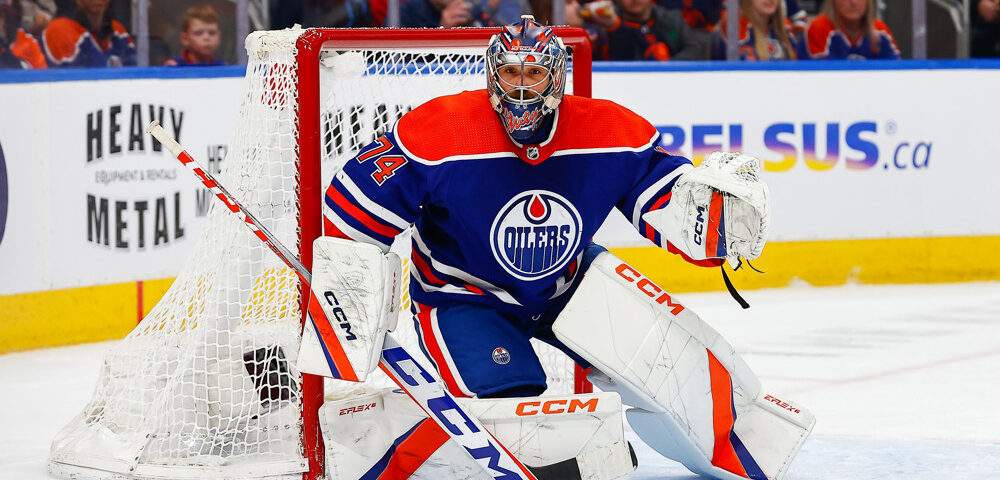
EDMONTON, AB - MARCH 30: Edmonton Oilers Goalie Stuart Skinner (74) makes a big save in the second period of the Edmonton Oilers game versus the Los Angeles Kings on March 30, 2023 at Rogers Place in Edmonton, AB. (Photo by Curtis Comeau/Icon Sportswire)
June 28, 2025 by Ryan Lotsberg
Goaltending is consistently a hot button issue when it comes to the Edmonton Oilers. The current tandem of Stuart Skinner and Calvin Pickard are feeling the heat on the heels of a second consecutive loss in the Stanley Cup Final. The Florida Panthers scored at least three goals in all six games of the 2025 Stanley Cup Final, and four or more goals in the last five games of the series. The Oilers lost by at least three goals in three of the four losses in the series.
Pickard had a wonderful playoff run where he remained undefeated until Game 5 of the Stanley Cup Final and finished with a 7-1 record, but he and the team were unable to deliver when it mattered most. One could argue that the Oilers wouldn’t have gotten as far as they did this past season without Pickard, but one could also argue that it felt like lightning in a bottle.
Skinner ended up going 7-6-1 (with the split decision coming as a result of being pulled in Game 4 of the Stanley Cup Final), but we saw play at the two extreme ends of the spectrum from Skinner in the playoffs. It wasn’t until Skinner’s eighth start of the playoffs where he posted a save percentage between .833 and 1.000. That pretty much sums up Skinner’s career thus far. He’s great when he’s on, but he’s terrible when he’s not at his best.
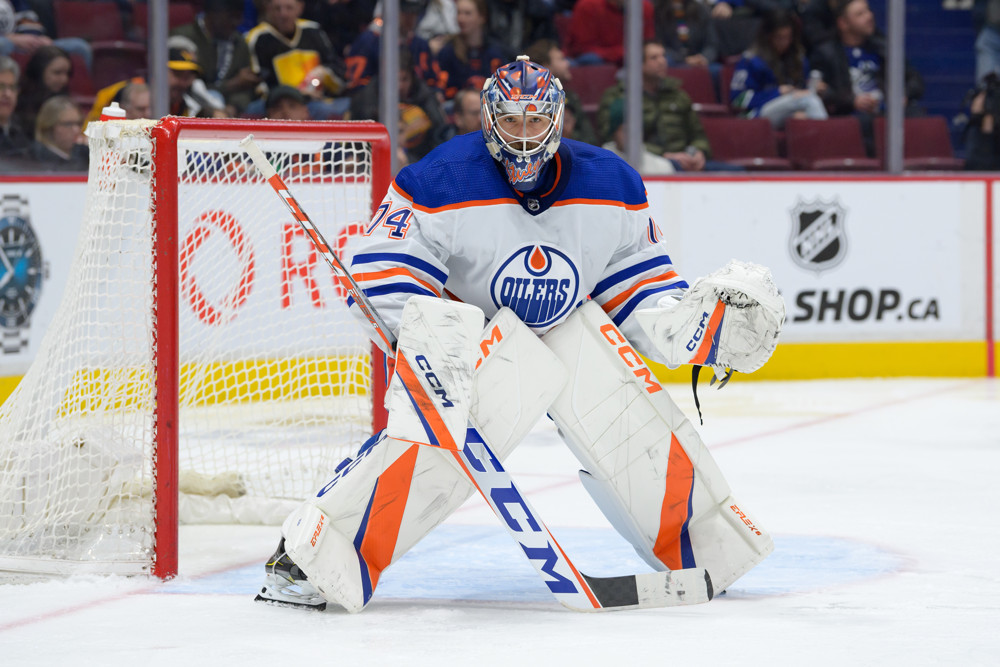
The problem with the OIlers goaltending is that it doesn’t inspire confidence. That isn’t good enough for a team in a championship window with Connor McDavid and Leon Draisaitl in their primes, especially considering that McDavid is eligible to sign an extension as early as July 1. Winning is the most important thing to him, and he needs to see that there’s a plan for prolonged success in place. The heat is on Oilers GM Stan Bowman to address the goaltending issue this summer.
Unfortunately, the goaltenders in this free agent class don’t inspire much confidence either. On the 32 Thoughts podcast, Elliotte Friedman said that the Oilers feel the same way and will likely explore the trade market for a goalie.
John Gibson was the biggest name out there. He was recently linked to the Oilers, but he was traded to the Detroit Red Wings on Saturday morning. Naturally, many Oilers fans are upset at that development because it means the OIlers missed out on what they viewed to be a clear upgrade that was available and reportedly willing to come to Edmonton. I’m honestly not upset by it in the least.
Related: Deep Dive: Skinner vs Gibson & Vejmelka
According to The Hockey Science, the prime age range for goalies is 24-33. Most goalies peak between the ages of 26 and 29. Those figures were arrived at using data from goalies that played five or more seasons in the NHL.
Skinner is 26 years old. A lot of people have argued that Skinner is likely to improve because he’s so young. We might not have seen his true peak yet, but he’s right at the start of the range where peak performance is typically reached. He has another few years left of operating at or near peak performance before a slight drop can be expected after 29. I would argue that Skinner isn’t likely to develop into a top tier NHL goalie at this point. The data says that he is unlikely to improve much going forward. It’s just a matter of how long he can hold on to this level.
Gibson will be 32 years old by the time next season starts. He’s near the end of the “prime” age range. As you’ll see later in this piece, Gibson had an outlier of a good season last year at the age of 31. Gibson’s peak years are behind him. The danger in acquiring a 32-year old goaltender is that the edge of the cliff is near, and there’s no way of knowing when the player will jump.
The following is a list of the Stanley Cup winning goaltenders since 2006 and their age of at the time of the win:
2025: Sergei Bobrovsky – 36
2024: Sergei Bobrovsky – 35
2023: Adin Hill – 27
2022: Darcy Kuemper – 32
2021: Andrei Vasilevskiy – 26
2020: Andrei Vasilevskiy – 25
2019: Jordan Binnington – 25
2018: Braden Holtby – 28
2017: Matt Murray – 23
2016: Matt Murray – 22
2015: Corey Crawford – 30
2014: Jonathan Quick – 28
2013: Corey Crawford – 28
2012: Jonathan Quick – 26
2011: Tim Thomas – 37
2010: Annti Niemi – 26
2009: Marc-Andre Fleury – 24
2008: Chris Osgood – 35
2007: JS Giguere – 29
2006: Cam Ward – 22
Eight goalies were 26 – 29 years old when they won the Stanley Cup in the last twenty years. Six were 25 years old or under, and six were over the age of 30. Two of those six wins by goalies over the age of 30 are accounted for by Sergei Bobrovsky, who won the last two Stanley Cups at the ages of 35 and 36. Corey Crawford won his second Stanley Cup when he was 30 years old. Chris Osgood had won two Stanley Cups as a backup with the Detroit Red Wings in 1997 and 1998 before winning the 2008 Stanley Cup as the starter (Osgood replaced the injured Dominik Hasek as the starter during the first round of the 2008 playoffs).
If we focus only on the age of the goalies when they won their first Stanley Cup, then six goalies won it between 26-29 years old, five won it at 25 years old or less, and four won it after turning 30.
Stuart Skinner is 26 years old, and Gibson is on the wrong side of 30. Based on age alone, Skinner is more likely to win a Stanley Cup than Gibson is; but this analysis can’t be based on age alone. A bad 26-year old goaltender has lower odds of winning a Stanley Cup than a good 32-year old goaltender.
I’m going to take you through an unbiased analysis of some underlying numbers for Skinner and Gibson to evaluate which goalie would be the better option to move forward with. Most people will just look at their basic save percentages and goals against averages from last season and surmise that Gibson is a no-brainer over Skinner; but I’m going to go deeper than that. Skinner played on a Stanley Cup finalist, and Gibson’s Anaheim Ducks missed the playoffs. There’s a difference in the quality of play in front of them, so I looked exclusively at performance above expected in this analysis. That removes the quality of the team in front of them as a factor. All the stats used in this analysis were pulled from Moneypuck.
Let’s start with the 2024-25 season. I have included Skinner’s playoff numbers here in addition to regular season numbers for both Skinner and Gibson.
| Sv% > x (low) | Sv% > x (Mid) | Sv% > x (High) | GSAx/60 | GAA > x | |
| Skinner (24-25 Playoffs) | 0.05 (5th) | -0.037 (17th) | 0.068 (13th) | 0.000 (12th) | 0.000 (12th) |
| Skinner (24-25 Regular Season) | -0.009 (41st) | -0.024 (50th) | 0.124 (15th) | -0.031 (42nd) | -0.03 (41st) |
| Gibson (24-25 Regular Season) | 0.011 (1st) | 0.01 (24th) | 0.057 (60th) | 0.588 (7th) | 0.59 (7th) |
First, a comment about Skinner’s playoff run. The sum of the whole ended up being marginally better than his regular season, but the inconsistency was the maddening part of his game. He needs to find a way to stop the bleeding when things aren’t going well.
Gibson ranked near the top of the league in goals saved above expected per 60 minutes (GSAx/60) and goals against above expected (GAA > x) during the regular season, and Skinner ranked poorly. Gibson stopped the shots he was supposed to stop, but his performance gradually got worse as the level of danger rose. Skinner was the opposite. He outperformed Gibson on high danger chances by a significant margin, which seems strange knowing that Gibson is better at moving laterally than Skinner is.
The analysis wouldn’t be complete if we only looked at one season. We need to compare their results in the previous two seasons as well, which takes us to the start of Skinner’s career. Here are the results for 2023-24:
| Sv% > x (low) | Sv% > x (Mid) | Sv% > x (High) | GSAx/60 | GAA > x | |
| Skinner (23-24 Playoffs) | -0.01 (14th) | 0.003 (10th) | 0.13 (6th) | 0.083 (13th) | 0.008 (13th) |
| Skinner (23-24 Regular Season) | -0.007 (39th) | 0.000 (24th) | 0.086 (35th) | 0.036 (35th) | 0.04 (34th) |
| Gibson (23-24 Regular Season) | -0.013 (61st) | -0.008 (37th) | 0.078 (40th) | -0.225 (59th) | -0.22 (59th) |
Skinner outperformed Gibson in every single one of these metrics in 2023-24. That doesn’t mean that Skinner was lights out good. I would say he was mediocre at best. Gibson was just that bad in 2023-24. His jump from 59th in GSAx/60 and GAA > x to seventh in those categories the next season is really hard to explain.
Skinner’s playoff run in 2023-24 was slightly better than his 2024-25 run, but it still wasn’t great. To be fair to Skinner, he outperformed Jake Oettinger in the Western Conference Final, and his save percentage and GAA was better than Bobrovsky’s in the 2024 Stanley Cup Final.
Here’s the table for Skinner’s rookie season in 2022-23:
| Sv% > x (low) | Sv% > x (Mid) | Sv% > x (High) | GSAx/60 | GAA > x | |
| Skinner (22-23 Playoffs) | -0.008 (16th) | -0.046 (20th) | 0.023 (14th) | -0.601 (20th) | -0.6 (20th) |
| Skinner (22-23 Regular Season) | 0.002 (18th) | 0.009 (29th) | 0.001 (60th) | 0.141 (25th) | 0.14 (26th) |
| Gibson (22-23 Regular Season) | -0.001 (24th) | -0.037 (71st) | 0.006 (28th) | -0.23 (57th) | -0.23 (56th) |
Skinner was only bested by Gibson in one category in 2022-23. His rookie season was his best season to date; but he had a poor playoff run that year, which should be expected as a rookie.
Skinner has fared better than Gibson has in these statistical categories throughout his three NHL seasons. The reality is that Gibson has not ranked highly in these categories in the 2020s save for a precious few exceptions where he randomly pops up at or near the top of one category. Gibson had a great season in 2024-25; but last season was the first time his save percentage was above .904 and his goals against average was below 2.98 since 2018-19.
The smart money is not on Gibson repeating last year’s performance at the age of 32. Peak Gibson was better than Skinner will ever be, but peak Gibson is a thing of the past. The smart money is not on Gibson repeating last year’s performance. It’s fair to think that he will be better than he was in the first half of the 2020s on a bad team if he was to play for a good team, but it would be unwise to expect the level we saw from him last season.
The cost to get Gibson ended up being Petr Mrazek ($4.25 million), a 2027 second round pick, and a 2026 fourth round pick. The Oilers would needed to have had the Ducks retain salary on Gibson, which is not something they were keen on doing. That would have driven the price up. It still would’ve been doable, but those assets could be better utilized by the Oilers. I would not have been in favour of including Skinner in the package to acquire Gibson.
While many Oilers fans are outraged after missing out on Gibson, I fully believe that they made the right choice to not pull the trigger on Gibson. I’ll share my preferred Oilers goaltending options in another piece tomorrow.

2 Comments
If you’re going to judge Gibson after being in a dumpster fire like the ducks, and also wanting out for awhile . You think he actually is playing his best hockey and not taking extra long injury breaks because he’s playing meaningless hockey. Oilers really can’t afford to wait for skinner’s reclamation project.. so if they don’t find an answer outside of skinner and pickard, they won’t win, and McDavid I’m sure will leave. If there is nothing done before season starts, it will be huge restart, and they should have done it when they had the assets. Gibson will probably play his best hockey, and we will see what we missed out on.
[…] Related: The Oilers missing out on Gibson is for the best […]