The math behind activating Hyman from LTIR
November 15, 2025
Wallstedt blunder haunts the Oilers
November 21, 2025Oilers 5v5 issues fall more on the players than the coach
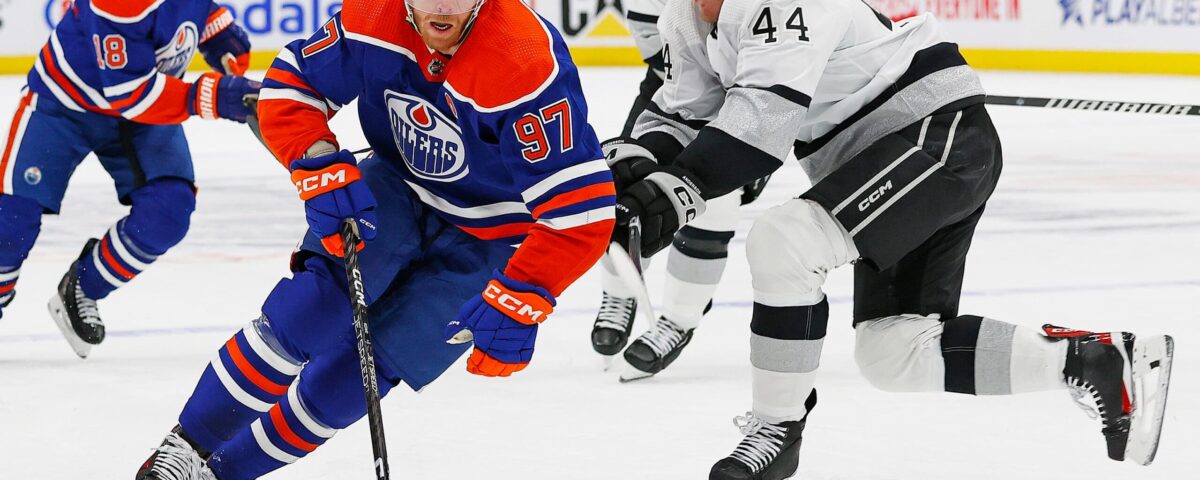
Photo Credit: usatoday.com/sports/
November 19, 2025 by Ryan Lotsberg
After yet another dismal performance by the Edmonton Oilers, this time a 5-1 loss at the hands of the Buffalo Sabres, I find myself writing another piece about what’s wrong with the Oilers this season.
Related: The Oilers are STRUGGLING at five-on-five
The fact that the Oilers are struggling to generate scoring chances and to score at five-on-five has been well documented. What people are struggling to figure out is why the team can’t produce offence. Oilers head coach Kris Knoblauch has taken the brunt of the blame for that online.
Jonathan Willis put out a piece where he outlined that the Oilers are having trouble generating offence off the rush. He stated that the Oilers only have nine rush chances at five-on-five in the first 21 games of the season compared to 52 at this point last season and 36 in 2023-24. That meshes with my observation as well. The Oilers are having trouble generating rush chances, which is impacting their overall ability to generate scoring chances of any kind and to generate offence.
He also referred to work by NHL Sid that pointed out that the Oilers have the highest percentage of shots from their defencemen than any other team in the league so far this season. Excessive use of point shots has been a concern brought up by multiple people on X thus far this season.
Willis’ argument is that coaching has a lot to do with these trends, but I believe that the issue is a player related issue more than a coaching issue.
One thing that changed this summer is the assistant coaching group. Glen Gulutzan and Paul Coffey left the bench over the summer. Paul McFarland was brought in to run the powerplay, and Coffey was not replaced. Mark Stuart has had running the defence added to his plate, which already had the penalty kill on it.
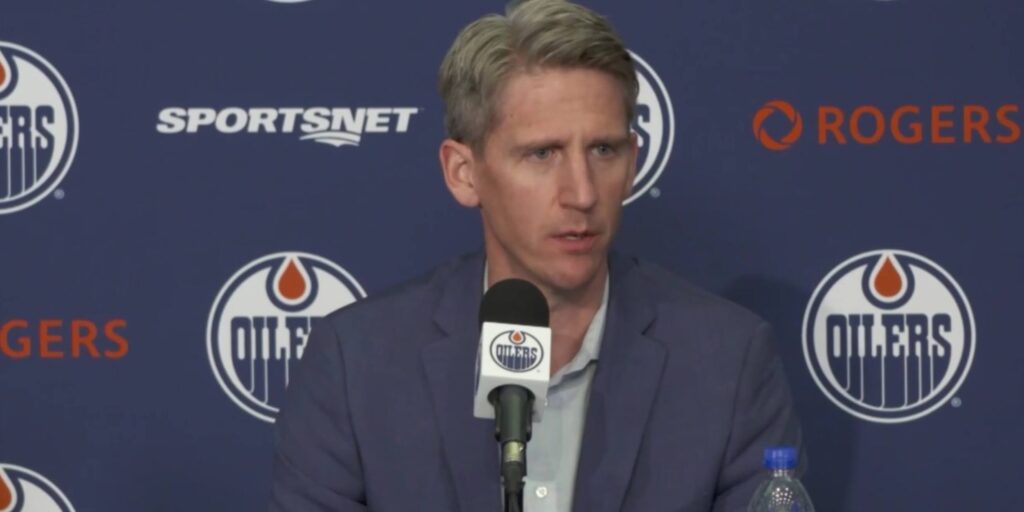
Knoblauch is responsible for five-on-five systems. Knoblauch was the coach last season when the Oilers got 52 rush chances in their first 21 games. He has also gone to back-to-back Stanley Cup Finals without making any major systemic changes from one year to the next. Suddenly, the team’s output of rush chances has dropped to about a sixth of what it was at this point last season for some reason.
The other thing that has changed is the forward personnel. So far, six new or rookie wingers have played for the Oilers this season. Noah Philp is a seventh forward in this category (15 NHL games played last season technically makes him a rookie this season), but he plays centre. That’s a lot of turnover and a lot of new faces.
That’s the crux of the reason why I think the team has struggled so much so far, but let’s go deeper.
Rush Chances
Let’s look at the anatomy of a rush chance. Rush chances are considered odd-man rushes where the attackers outnumber the defenders. Those situations come about from turnovers or perfectly executed defensive zone exits. According to McFarland, 68% of odd-man rush goals in the first round of the 2022 playoffs came as a result of defensive zone exits and “quick hit transitions”, or quickly getting on the attack after the other team commits a turnover. McFarland presented that information in a presentation called “The Importance of Attacking off the Rush”. Knoblauch hired McFarland this summer. If you don’t think these two coaches are aligned in their philosophies and that they don’t think attacking off the rush is important, then I don’t know what to tell you.
It’s rare that a rush chance happens as a result of a breakout where both teams are set. They happen the most often off turnovers, whether they be in the defensive zone or the neutral zone. That tells me that the Oilers aren’t creating enough turnovers in those two zones, and they aren’t exiting the defensive zone with control quickly enough to generate rush chances when they do get turnovers in their own zone.
Not being able to create turnovers in the defensive and neutral zones is another part of this issue. That means that the defensive zone coverage is poor. The defensive zone system isn’t any different than it was last year, but it is not being executed well at all this year. That’s not on the defencemen alone, it’s on the forwards too.
Darnell Nurse will likely be blamed for Noah Ostlund’s second goal on Monday when he carried the puck around the net and walked into the faceoff circle and scored without an Oiler getting anywhere near him. Ostlund emerged from behind the net on Nurse’s side, but Nurse was tied up with another player near the post on that side of the ice. That player by the net was his responsibility, and he was on it. I’m not going to exonerate Nurse of any wrongdoing this season because he has STRUGGLED, but this goal was not his fault.
It was just after a faceoff. Curtis Lazar won the faceoff back into the corner. Jake Walman lost the race to the puck. Vasily Podkolzin clearly thought Walman was going to win the race to the puck because he took off up the ice. He was not in the frame when the goal was scored. Jack Roslovic was covering the man in the slot, which should have been Lazar’s job as the centre. Lazar was in no man’s land. He had to try to get out to Ostlund before it was too late, and that didn’t happen. Place some blame on Walman for not getting to the puck off the faceoff if you must, but everything that happened after that was on the forwards making mistakes in the defensive zone.
I can’t tell you exactly what the Oilers are being told to do tactically on their defensive zone exits and breakouts, but here’s what I have observed. The Oilers have been sending one forward to the far blue line as part of their playbook as far back as the Dave Tippett era. That tells me there hasn’t been much change over the years.
Why would Knoblauch suddenly change his defensive zone exit and breakout tactics drastically when they have gotten him to back-to-back Stanley Cup Finals? I could understand some minor tweaks since the Florida Panthers have clearly found a way to slow the Oilers down, but drastic wholesale changes don’t make sense. That isn’t what I’ve observed.
This season, they haven’t been able to generate much from that specific tactic (or any breakout tactic for that matter). The long passes aren’t being completed, and they aren’t winning the races to the loose pucks when they aren’t completed. The system hasn’t changed as far as I can tell, but the execution of it has.
There’s a lack of NHL experience in that group of seven new faces, but Ike Howard is the only one that’s a true professional rookie this season. He’s down with the Bakersfield Condors now. The others all have enough professional experience to be able to learn breakout plays and execute them in a reasonable matter of time.
Three of the seven new faces are established NHL veterans that should be able to understand and execute any system or play presented to them, no excuses. A fourth, David Tomasek, has a lot of professional experience in Europe, so understanding the concepts shouldn’t be hard for him; but execution on a smaller ice surface against faster players is likely an issue early in the season.
I’ve often seen multiple wingers trying to go deep on the same side of the ice, like Andrew Mangiapane and Mattias Janmark both did prior to a glorious scoring chance by Ryan McLeod in Monday’s loss to the Sabres. That’s a complete execution issue as far as I can tell. I don’t think that’s in the playbook.
I attended the home game against the New York Rangers in October and had a great view of the action from behind the Rangers net. The Oilers struggled to get the puck through the neutral zone with control. The Rangers weren’t doing anything special. It was a simple 1-2-2 neutral zone system. It was a bit tighter than some other teams play as all five Rangers were consistently between the faceoff dots, but it wasn’t an exotic scheme by any stretch. The Oilers had trouble completing passes, and they looked slow attacking through the neutral zone. Even the forwards without the puck were slowed down because the puck wasn’t moving fast enough. I honestly couldn’t tell what they were trying to do because they looked so disconnected.
In his October tactics piece, Bruce Curlock mentioned that the defencemen are more comfortable with moving backwards with the puck rather than advancing it up ice as quickly as they can. When a defenceman turns back with the puck, it means there’s no passing play available up the ice. He has to turn back because a forechecker is closing in on him and he doesn’t want to give the puck away.
I think some people are mistaking cautious play for a lack of available options. If there was a pass to be made, the defenceman would make it. Instead, forecheckers are closing on Oilers defencemen more quickly than usual. It’s not because the defencemen are suddenly worse at hockey. It’s because the forwards aren’t getting open. They aren’t doing what they need to do on defensive zone exits and breakouts.
That always makes defencemen look bad, especially to those people watching on TV because the camera never shows the forwards up the ice when a defenceman has the puck. The defencemen are getting into more situations where they are being forced to improvise with the puck in their own zone to avoid pressure from forecheckers as a result of the forwards not being able to get open up the ice, and they’re struggling at that aspect of the game.
There’s one new defenceman on the team, and he has barely played. There are many new forwards. It’s fair to argue that all of the defencemen on the team have taken their turns struggling at times this season, but I put the lack of rush chances being created more on the forwards than on the defencemen not getting them the puck fast enough.
Shots From Defencemen
Consider this about the shots coming from defencemen. The numbers presented by NHL Sid are ratios. The numbers are presented in a way that makes us think that the defencemen are shooting more and are being instructed to do so.
The truth is that only one Oilers defenceman is shooting at a higher rate than he did last year (Brett Kulak) according to information pulled from Natural Stat Trick. The others are all shooting less frequently than they did last year.
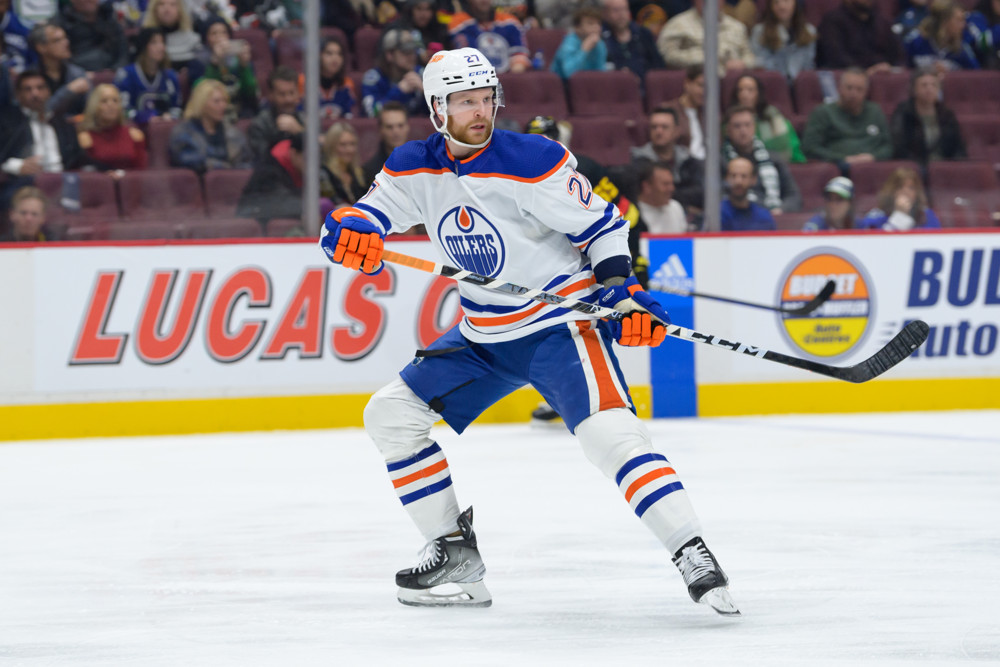
The only Oilers forward that was with the team last season that is shooting more frequently than he did last season is Adam Henrique. Everyone else is shooting less often. Leon Draisaitl’s five-on-five shot rate has gone from 7.46 shots per 60 minutes to 4.3. Is the reigning Rocket Richard Trophy winner being told to shoot less? I don’t think so. Roslovic is the only new Oilers forward who is shooting at a higher rate this season than he did with his former club last season, and that’s by a slim margin (6.98 up to 7.33).
Last year, the Oilers had three forwards that shot at a rate greater than eight shots per 60 minutes (Trent Frederic is technically a fourth, but he played 7:04 in one game for the Oilers during the regular season, so he doesn’t count). This year, they have zero such players.
The fact of the matter is that you need to get the puck in open space in dangerous shooting positions in the offensive zone if you want to get more shots. That isn’t easy, especially in the NHL.
Space isn’t given in the NHL, it’s earned. Oilers forwards aren’t getting to the middle of the ice with the puck in the offensive zone often enough because they aren’t creating breakdowns in the other team’s defence.
That happens when battles are won along the wall and the offensive team is able to catch the defensive team out of position, or when creative movement away from the puck opens up passing lanes. The Oilers are too comfortable with protecting the puck along the wall and working the puck around the perimeter. They aren’t winning races to the middle of the ice after winning puck battles along the wall, and there’s a total lack of creative movement. Their offensive zone time isn’t leading to dangerous chances often enough, and it shows.
I can’t tell you what Knoblauch is telling his players to do in the offensive zone. I have a hard time believing that his system is predicated upon protecting the puck on the outside and hammering point shots. It never has been, and I don’t know why it would suddenly be the case now. I somehow doubt that the forwards are being asked to shoot less. I’m sure they’re trying to get more shots and scoring chances, but they have just been ineffective. They need to move their feet more and create space in the offensive zone. It’s as simple as that.
Wrap
The coach implements the systems and it’s his responsibility to make sure his players understand them; but he can’t go out there and execute for them. The players need to execute their breakouts and defensive zone exits better, and they need to find a way to be more dangerous in the offensive zone. The forwards need to get their act together, especially the wingers.
The reality is that all systems work if executed properly. Some are better fits for certain players and certain rosters, but they’re all designed to work. I don’t think the players not executing the systems well enough early in the season is entirely the coach’s fault, but I’ll say that it is his problem to fix. He either has to make some tweaks or get his players to figure it out somehow. That’s hard to do with limited practice time due to a condensed schedule, but he has to find a way.
Everyone in the organization has some share of the blame for the team’s awful start, but I place most of the blame on the players themselves. We also have to realize that injuries have been a factor to start the season. Zach Hyman has only played in two games, and Janmark has only played in five games. Kasperi Kapanen will have missed at least six weeks of action by the time he returns. Ryan Nugent-Hopkins has already missed the last five games, and he will not play before the end of this seven-game road trip. At full health, Matt Savoie will be the only rookie left in the lineup. The list of new faces in the forward group will go from seven at the start of the season to as little as three. That gives me a little bit of hope that things will get better for this forward group, but I still contend that it isn’t as strong as recent iterations of Oilers forward groups have been.
Next in line, I have the management team for assembling this roster; but the reality of the situation is that the cap went up by $7.5 million and two important players got raises that added up to $12.4 million this summer. That meant that sacrifices had to be made and younger, cheaper players had to be brought in. The roster took a step back, but that was out of necessity.
The coaching has the LEAST amount of blame in this situation. Knoblauch is over-extending Connor McDavid and Draisaitl, but I would also argue that nobody else is giving him a reason not to. One could argue that they aren’t getting an opportunity to show what they can do because the dynamic duo gets all the ice time, but you have to earn your ice time in the NHL. Make it hard for the coach to keep you off the ice. The bottom six goal share without McDavid and Draisaitl on the ice is at 23% this season, which is even worse than it was when they were just babies in this league and the team was still dreadful. That isn’t indicative of players that deserve more ice time.
This might not be the coach’s fault, but it’s his problem to fix. The truth will begin to reveal itself more as the team returns to full health and the team gets more practice time once the ridiculous portion of their travel schedule settles down.