

What are the Edmonton Oilers getting in Ike Howard?
August 24, 2025
Potential McDavid Milestones for 2025-26
September 16, 2025
September 9, 2025 by Ryan Lotsberg
The hockey world is waiting with bated breath for the best player on the planet, Connor McDavid, to sign an extension with the Edmonton Oilers. He was eligible to do so on July 1, 2025; but the Oilers captain is taking his time with his decision.
McDavid wants to win more than anything; but he rightfully also wants to be paid what he’s worth, which is a lot. Taking less money is what would be the most helpful to the Oilers in trying to build a winning team around him. He’s trying to think of a solution that works for both sides.
He told reporters that “all options are on the table” on September 5. I want to go through the potential contract options that are likely on the table. I’m going to approach this from McDavid’s perspective. The Oilers would love the maximum eight-year deal at the lowest cap hit possible, but that isn’t necessarily what’s best for McDavid.
McDavid’s Previous Contract
McDavid’s last deal was an eight-year, $100 million deal with an average annual value of $12.5 million that went into effect for the 2018-19 season. According to PuckPedia, that took up 15.72% of the $79.5 million salary cap for that season. It was a front-loaded contract that saw him earn $15 million in the first year of the deal and $10 million in the final year (which is this coming season). A high percentage of his salary was categorized as “signing bonuses” for each season. Signing bonuses are paid at the start of the NHL calendar (July 1), which means that the player gets paid upfront and the signing bonuses don’t get included in calculations for buyouts. This strategy makes a contract more buyout-proof for players, which gives them additional security. That’s likely going to be something the McDavid camp asks for again this time around.

The Rumours
Many rumours have suggested that McDavid will sign a three or four-year deal with an AAV somewhere between $16 million and $17 million.
McDavid took up 15.72% of the salary cap in the first year of his last contract. 15.72% of $104 million is $16,348,800. Only a figure above $16.35 million would be an increase in the percentage of the team’s cap hit that he takes up in year one, or what I would call a “raise”.
$17 million is 17.68% of $104 million. That’s the high end of what I would be willing to consider a “team-friendly” AAV.
Basically, the rumours are suggesting a team-friendly cap hit on a mid-length contract.
Option 1: Mid-Length Term
A three or four-year contract would carry a reasonable cap hit between $16 million and $17 million in my estimation.
The benefit of this option for McDavid is that it would ease the burden of his contract on the team for the first season or two after the cap reaches $113 million. That would give the Oilers more cap space to work with to make the team more competitive at that time.
The downside for McDavid in this scenario is that he would be delaying being able to capitalize on the rising salary cap, which could cost him some money in the long run.
Option 2: Short Term
As stated earlier, the NHL’s salary cap is expected to rise to $113 million for the 2027-28 season. For what it’s worth, Auston Matthews signed a four-year contract with the Toronto Maple Leafs which started last season and runs through 2027-28. By then, we will know if the cap will stop climbing or not. Matthews is in position to capitalize on the high salary cap. McDavid could do the same thing by signing a one-year deal.
The 2025-26 season is the final one of McDavid’s current contract. One more year will elapse after that before the salary cap reaches $113 million. Who knows what will happen beyond that time, but it will likely flatten out for a little while after jumping from $88 million in the 2024-25 season to to $113 million in 2027-28.
The limit for any player’s AAV is 20% of the team’s salary cap. McDavid won’t demand the maximum value, but 20% of $113 million is higher than 20% of the $104 million salary cap expected for 2026-27.
Why would McDavid lock himself into a lower AAV for eight years now when he can earn more money by signing a long-term contract that starts in 2027-28?
In this scenario, McDavid could sign a one-year contract worth somewhere between $16 million and $17 million before locking in for a longer term at a higher AAV once the salary cap is done climbing. A two-year deal signed now would only delay his big payday by one year.
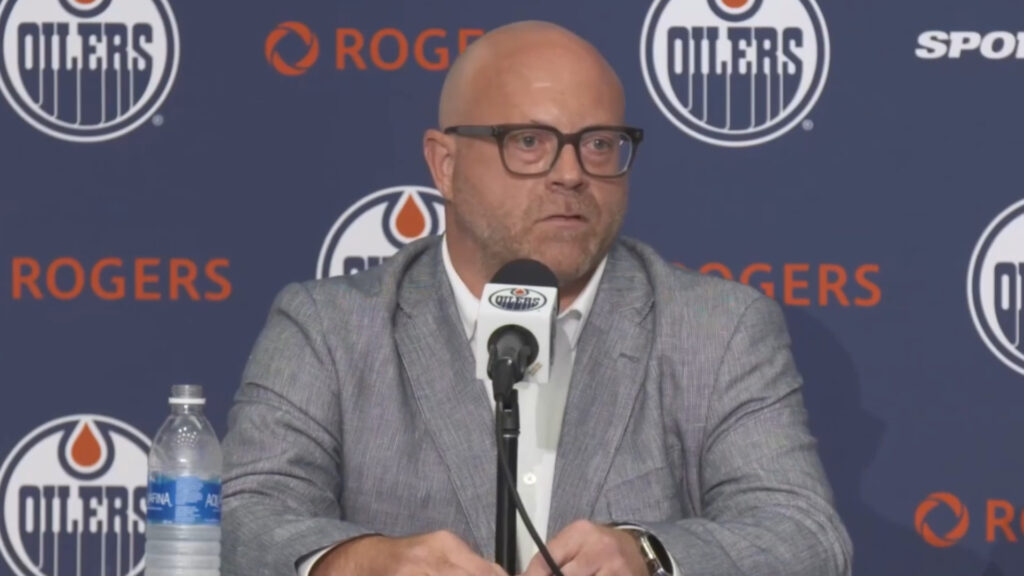
Signing a short-term deal would allow him a little bit more time to see how the roster continues to evolve under Oilers GM Stan Bowman. The team got younger and faster this summer, but they lost a wealth of experience as well. The prospect pool is getting stronger thanks to some creative work by Bowman and his staff, but it’s still considered weak in comparison to others around the league. The pipeline will need to get flowing quickly if the Oilers want to compete for the duration of a long-term deal with McDavid. He would never say that he has doubts about the direction of the team publicly if he did have doubts; but if you have time to evaluate, then it makes sense to take it.
Option 3: Max Term
More term usually costs more money. We just saw this scenario play out with Evan Bouchard, who signed a four-year deal with an AAV of $10.5 million that starts this coming season. A long-term contract would’ve come with a higher AAV, which is something that the Oilers did not want to do. It would be no different with McDavid.
When we think about the percentage of a team’s cap hit that a player takes up, we usually think about it for the first season of that contract. It obviously goes down as the cap rises over time.
The rumoured $16 million to $17 million AAV for McDavid’s contract is approximately 16% of the cap in 2026-27, so let’s use 16% of the cap in this example. 16% of the cap in 2026-27 is $16.64 million. It would be nice for the Oilers to be able to lock McDavid up at that price for the maximum term, but that would be a team-friendly deal.
16% of the cap is fractionally higher than the 15.72% McDavid started with in 2018-19. It wouldn’t reflect his career accomplishments to date or what he is likely to do in the future.
Singing long-term now would mean that McDavid would not be able to capitalize on the rising salary cap. When the salary cap rises to $113 million in 2027-28, 16% of that will be $18.08 million. McDavid would be well within his rights to ask for at least that much on an eight-year deal now knowing that he would be missing out on the opportunity to take advantage of the rising salary cap.
McDavid is worth the full 20% maximum. Nobody would bat an eyelash if he was to ask for 18%. 18% of $113 million is $20.34 million. $18.08 million to $20.34 million is likely the AAV range that it would take to get an eight-year deal done with McDavid now in my opinion.
As much as the Oilers and their fans would love the security of knowing McDavid will be around for eight more years after this one, that price would significantly impact the Oilers’ ability to improve their roster in the next two seasons. McDavid wants to win more than anything, and signing an eight-year deal right now would hinder his ability to win in the next two years, which are prime years of his career.
Option 4: Deferred Salary
Shohei Ohtani of the Los Angeles Dodgers signed what was the largest contract in the history of professional sports at the time when he signed his ten-year, $700 million contract on December 9, 2023. The most interesting thing about that contract is that $680 million of it is deferred salary, meaning it won’t be paid to Ohtani until after the contract expires. He will make $2 million per year for the duration of the contract, then he will be paid $68 million per year for the next ten years after the contract expires.
Ohtani carries risk by agreeing to that kind of a deal. He risks not getting that money if he was to suffer a debilitating injury of some kind or if the franchise was to fold. Those are unlikely scenarios though. The biggest risk he carries is that the present value of dollars is higher today than it is in the future, so his $680 million would be worth more now than it will be ten years from now.
Tax savings are the biggest benefit Ohtani could get from deferring his salary. California has a high tax rate, especially for high income earners like Ohtani. If he was to move to a state with no taxes after his contract expires, then he would not be taxed on the $680 million set to be paid to him. Deferring his salary means that only $20 million of it would be taxed by California during the ten-year term of the contract.
Ohtani deferring his salary benefits the Dodgers the most. They can have Ohtani on the team and still afford to spend ridiculous amounts of money on other players.
Naturally, Oilers fans that are aware of this have wondered if this is a feasible option for McDavid and the Oilers, myself included.
The MLB is not the NHL. There’s no salary cap in the MLB. Players can defer salary in the NHL, but the immediate benefit to the team isn’t as great as it is in the MLB.
Seth Jarvis is the most recent NHL player to defer salary in his contract. Jarvis’s contract is an eight-year deal with an AAV of $7,420,087. $15.67 million is being deferred and paid out a day after his contract expires. CapWages did a great piece about salary deferral after Jarvis signed his contract, so I’ll leave it to them to explain how the cap hit is calculated because my tiny little brain can’t comprehend the math. Their math says that the Carolina Hurricanes will save $478,750 against the cap per season by deferring that $15.67 million over eight years. That isn’t a lot of cap space gained for the amount of salary that was deferred.
McDavid deferring salary would be the most team-friendly approach he could take; but a boatload of money would need to be deferred in order for the Oilers to gain a significant amount of cap space. The little bit of cap space the Oilers would gain from McDavid deferring salary wouldn’t be worth him taking the risk.
It could also be viewed as cap circumvention by the league. Sportsnet released a piece about the NHL having concerns about salary deferral after the Jarvis contract was signed. The salary deferral rule is something that pre-dates the salary cap era and just hasn’t been changed since then. NHL Deputy Commissioner Bill Daly said that it’s something that will “probably need adjustment on some basis going forward.”
As noted earlier in this piece, a significant percentage of McDavid’s last contract was made up of signing bonuses that were paid up front each season. That’s the exact opposite of salary deferral. While salary deferral could be a creative way to get McDavid the money he wants and to lower the cap hit for the team, it doesn’t make sense for McDavid to take on that kind of risk for how little it would actually help the Oilers’ cap situation.
Wrap
McDavid is at that point where he needs to maximize the amount of money he can get in his career. It’s a guessing game because nobody knows how high the salary cap will increase throughout the remainder of his career or how long he will be able to play.
McDavid will be 29 years old when his next contract starts. In all likelihood, he will have approximately nine or ten years left in his career at that time. That’s likely two contracts.
It could be one short one and one long one. It doesn’t matter which one comes first.
A short contract at the end of a player’s career is usually less lucrative because performance declines as players age, but McDavid is a special breed that’s likely to keep producing at a high level until he chooses to stop playing. He isn’t likely to get a significantly lower cap hit for that two-year contract at the end of his career.
Is the $16 million – $17 million cap hit on a two-year deal now more than what he could get on a two-year deal in 2034-35? Who knows how high the salary cap will be by then. It might work out that he could get more on a two-year contract then than he can get on a two-year contract now for all we know. That’s not a guarantee though. It might make more fiscal sense for McDavid to do a short-term deal now and sign a long-term deal a few years from now to avoid a situation where he has to sign a short-term contract at a low AAV at the end of his career.

We know that McDavid wants to win. That means he doesn’t want to put the team in a terrible financial position.
As much as Oilers fans want McDavid signed long-term right now, I don’t think that’s the best situation for the team because his AAV would be too high for the first two years of the deal. Those are prime years that the Oilers will need the most flexibility they can get to be able to add to their roster as the salary cap climbs.
McDavid’s final two NHL contracts don’t have to be a short-term deal and a long-term deal. They also could be two mid-length deals.
McDavid wants the best solution for himself and for the team. I believe that’s a three or a four-year deal at approximately 16% of the salary cap for 2026-27 ($104 million), which is $16.64 million.
Both sides would be giving something up in that scenario. The Oilers would be giving up some term, and McDavid would be delaying a bigger payday.
Having said that, it’s the scenario that gives McDavid and the Oilers the best chance at winning in the next four or five seasons.
A short-term deal would only give the Oilers the best chance to win in the next two or three seasons. An eight-year deal would bring McDavid’s AAV up to a point where it wouldn’t help the Oilers win in the short-term.
15.72%, the percentage of the cap he took up in the first year of his last contract, is pretty random; but it worked out to a round AAV of $12.5 million. I’ll say that he signs at $16.5 million for four years (15.87%).
That’s a high cap hit based on today’s standards, but let’s all be on the same page about that being a team-friendly cap hit because it’s a miniscule raise over the percentage of the salary cap that he started his last contract with seven years ago. If he’s willing to stay at that price point for any longer than a couple of years, it would be a huge win for the Oilers.
Regardless of what this contract looks like, I’m not worried about him going anywhere. The Oilers have done a lot to keep McDavid happy, and his best chance to win is in Edmonton. Which other team could afford the $16 million – $20 million to get him onto their payroll and still be competitive? The list is short if it exists at all.
Related: Why McDavid Isn’t Going Anywhere: Part One – Trade Requests
The only thing that hasn’t happened yet that might keep him from staying is not having won it all. They have been to the Stanley Cup Final two times in a row. It would be different if the team was middling and they weren’t a guarantee to make the playoffs every year as was the case with John Tavares and the New York Islanders, but that’s not how it is.
I’m not sure when McDavid will sign his next contract, but I’m certain that he will re-sign with the Oilers.

2 Comments
[…] Related: Deep Dive: McDavid’s Contract Options […]
[…] Related: Deep Dive: McDavid’s Contract Options […]